
- Home
- Investor Briefs
- Puerto Plata and Cabarete: The Complete Guide to How They Connect, What Each Offers, and Where the Transactions Actually Happen
Your search results
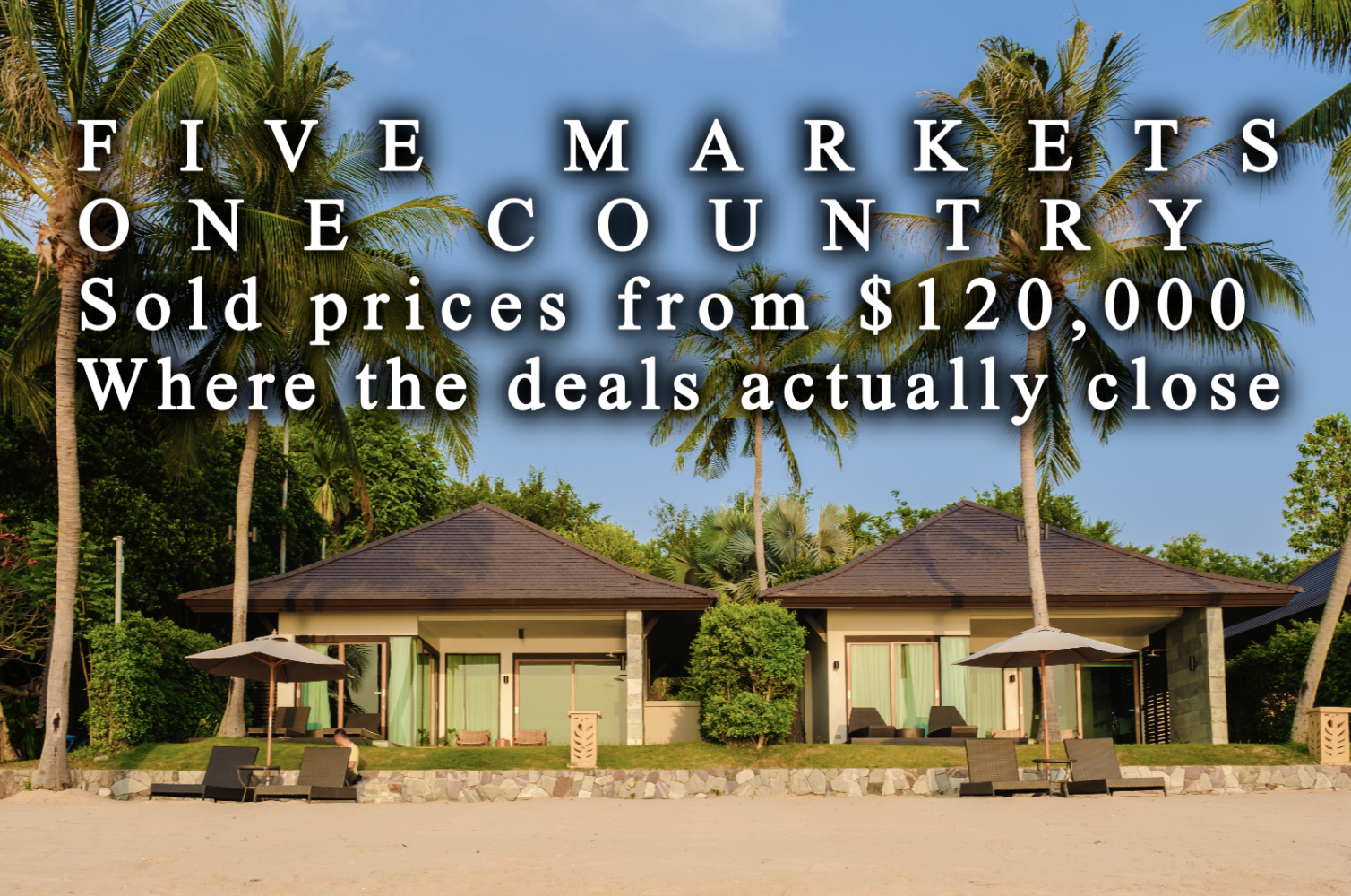
Puerto Plata and Cabarete: The Complete Guide to How They Connect, What Each Offers, and Where the Transactions Actually Happen
Search for Dominican property and you will mostly get listing portals showing thousands of results with no way to tell which region suits you or what anything actually trades for. Here's the real picture: how the five main markets differ, sold prices on the coast we work, and the transaction data showing where deals genuinely close.
Quick Answers
How much does property cost in the Dominican Republic?
On the North Coast, non-oceanfront property starts at $120,000, non-oceanfront villas run $200,000 to $600,000, oceanfront condos $150,000 to $2,000,000, and oceanfront villas $550,000 to $7,000,000.
Those are sold prices from completed Blue Sail Realty transactions in Cabarete. Portal figures are asking prices, which sit above what property trades for.
Where do most transactions actually happen?
Roughly 68% to 72% of tracked foreign-buyer closings on the North Coast occur in the Costambar-Cabarete corridor, and 55% of closings sit in the $220,000 to $399,000 band.
Mostly three-bedroom villas with private pools. That concentration is useful information: it tells you where the deepest pool of future buyers is.
What are the main property markets in the country?
Five: the North Coast, Punta Cana and the east, Samana and Las Terrenas, Santo Domingo, and the interior around Jarabacoa and Constanza.
Each has a genuinely different buyer, climate and price structure, and they are not interchangeable.
Which region is best value?
The North Coast prices below Punta Cana for comparable specification, largely because Punta Cana carries resort-adjacent land values and higher community fees.
For price per dollar on the water and a year-round community, the North Coast wins. For sheer short-stay rental volume, Punta Cana has the deeper market — and that is worth saying plainly.
What does it cost to buy, wherever I buy?
4% of the purchase price — a 3% transfer tax plus a 1% legal fee covering notary, filing, title transfer and contracts.
Published guidance says 4% to 9%, but that range reflects differing billing practice rather than market reality. Financing adds a 2% mortgage registration tax.
Can foreigners buy anywhere in the country?
Yes — full freehold title, identical rights to Dominican nationals, no residency, permit or local partner required, and no foreign-buyer surcharge on any tax.
The only universal restriction is the 60-meter maritime zone from the high-water mark, which is state land nationwide and cannot be privately owned by anyone.
Is there annual property tax?
IPI, at 1% per year, but only on appraised value above RD$10,695,494 — approximately US$182,000 for 2026.
Paid in two installments, March 11 and September 11. Property below the threshold owes nothing, which covers a substantial share of the entry-level market.
Do I need a Dominican bank loan?
Rarely — Dominican banks seldom finance foreign buyers, so most purchases here are cash, seller-financed or developer-financed.
That sounds like a constraint and functions more like a simplification: fewer moving parts, faster closings, and no mortgage registration tax.
How safe is Dominican property title?
The country uses a Torrens registration system in which the state guarantees registered ownership, which is a stronger foundation than the deed-recording model used across much of the region.
What your attorney confirms is a registered Certificado de Titulo with a completed deslinde. That combination is the strongest position the system offers.
Is the market growing?
Yes — tracked North Coast closings ran 9% ahead of the prior year in Q1 2026 and 12% ahead in Q2, against national arrivals up 59.5% on 2019.
Law 30-26 also cut capital gains tax on individual property transfers to a flat 10% in June 2026, which improves seller economics and tends to bring more stock to market.
The Five Markets, Honestly Compared
Buyers arriving at a national search usually have not yet decided on a region, and the regions differ more than the listings suggest. Here is the shape of each.
| Region | Character | Suits |
|---|---|---|
| North Coast (Cabarete, Sosua, Cabrera, Puerto Plata) | Atlantic coast, watersports culture, year-round international community | Value on the water, residential living, long-season rental |
| Punta Cana and the east | Resort-driven, highest tourism volume, gated developments | High-volume short-stay rental yield |
| Samana and Las Terrenas | Remote, scenic, strong European buyer base | Buyers wanting seclusion and willing to accept logistics |
| Santo Domingo | Urban apartment market, no beach premium | Long-term rental demand, city living, business base |
| Jarabacoa and the interior | Mountain climate, cooler, river valleys | Buyers prioritising climate over coast |
We work the North Coast, and it would be easy to write the other four as inferior. They are not. If your single priority is short-stay rental volume, Punta Cana has the deeper market and more established management infrastructure. If you want a Spanish-colonial city with genuine long-term rental demand, Santo Domingo is the answer and the coast is not. If you want to be genuinely away from things, Samana does that better than anywhere on the North Coast.
What the North Coast does uniquely well is combine low entry pricing with a community that functions all year. Cabarete's kitesurfing and surf reputation brings people outside conventional holiday windows, which means services stay open in low season and the resale market is not confined to a three-month window.
Sold Prices on the North Coast
Every figure below comes from completed Blue Sail Realty transactions in Cabarete rather than from listing aggregation.
| Property type | Sold price range |
|---|---|
| Non-oceanfront property, entry point | from $120,000 |
| Non-oceanfront villa | $200,000 - $600,000 |
| Oceanfront condo | $150,000 - $2,000,000 |
| Oceanfront villa | $550,000 - $7,000,000 |
| Hillside ocean-view building lots | $60 - $100 per m² |
The structural point worth understanding: Non-oceanfront villas top out around $600,000 while oceanfront villas start at $550,000 — the ranges barely overlap. At the top of this market the water frontage rather than the house accounts for most of the price, which means an oceanfront condo from $150,000 puts a buyer on the water for less than a mid-range inland villa costs.
Where Deals Actually Close
Listing portals show inventory. Closing data shows demand, and the two look different.
| Metric | Figure |
|---|---|
| Foreign-buyer residential closings tracked, Puerto Plata province, 2025 | approximately 2,050 |
| Share in the Costambar-Cabarete corridor | roughly 68%-72% |
| Closings ahead of prior year, Q1 2026 | 9% |
| Closings ahead of prior year, Q2 2026 | 12% |
| Share of closings in the $220,000-$399,000 band | 55% |
| Dominant property type in that band | three-bedroom villas with private pools |
| Net rental yields, independently corroborated | 6.5%-8.1% |
These figures were compiled from closings handled and tracked directly, cross-referenced against public Jurisdiccion Inmobiliaria registry filings and CONFOTUR registration records, and cited by Dominican Today in August 2026 alongside independent third-party sources. They are one firm's tracked data rather than an independently audited national count, which is how they were framed to the outlet and how they should be read here.
Two things follow. First, the mid band is where the market clears, and buying into it means buying into the deepest resale pool. Second, three bedrooms with a private pool is simultaneously the best-selling and best-letting configuration on this coast, which is unusual and genuinely useful — an owner is not choosing between personal use and rental viability.
What Buying Costs, Anywhere in the Country
| Item | Figure |
|---|---|
| Total buying cost | 4% (3% transfer tax + 1% inclusive legal fee) |
| With financing | 6% (adds 2% mortgage registration tax; falls to 1% in 2027, eliminated 2028) |
| Under CONFOTUR | 1% (transfer tax waived) |
| Annual IPI | 1% above ~US$182,000 appraised value; zero below |
| Capital gains on sale | flat 10% since Law 30-26, June 2026 |
| Foreign ownership | Full freehold title; no residency, permit or local partner |
Two of those lines are recent and worth flagging. Law 30-26, enacted 18 June 2026, cut capital gains tax on individual real estate transfers from a progressive scale topping out at 25% to a flat 10%, and put the mortgage registration tax on a path to elimination. Several widely-read overseas-property sites still publish the old figures, so check the date on anything you read about Dominican tax.
How to Narrow a National Search
1. Decide coast before you decide property
The Atlantic North Coast and the Caribbean south and east coasts have different climates, different water, and different rental seasons. Choosing region first removes most of the noise from a portal search.
2. Work in sold prices, not asking prices
Ask any agent whether a figure is a closing price or a list price. On this coast the gap is meaningful, and a buyer budgeting from asking prices consistently overestimates what they need.
3. Check where your price band sits
If 55% of closings happen between $220,000 and $399,000, a property priced well above that sits outside where most transactions occur. That is fine if you know it at purchase rather than at sale.
4. Confirm title before you fall for the property
A registered Certificado de Titulo with a completed deslinde is the smooth version of this purchase. Establishing that early rather than during due diligence is the single best predictor of a fast closing.
Questions worth asking on any Dominican property:
- "Is this a sold price or an asking price?"
- "Is this a Certificado de Titulo or a Constancia Anotada, and is the deslinde complete?"
- "Is this oceanfront, ocean-view, or walking distance - precisely?"
- "Does this property sit above or below the IPI threshold?"
- "Does it carry CONFOTUR, and how many exemption years remain?"
- "What is the community fee, and what has it done over five years?"
- "If I need to sell in five years, who is the buyer for this property?"
Sources and further reading:
Sold price ranges reflect completed Blue Sail Realty transactions in Cabarete, Puerto Plata province. Closing volume, corridor concentration, quarterly growth, the 55% share of the $220,000-$399,000 band and net rental yields of 6.5% to 8.1% were cited in Dominican Today, "Tax Reform, Tourism Records, and a New Resort: What's Behind the North Coast's Real Estate Growth" (August 2026), drawing on Blue Sail Realty's tracked closing data cross-referenced against public Jurisdiccion Inmobiliaria registry filings and CONFOTUR registration records, presented as one firm's tracked data rather than an independently audited count. National arrivals up 59.5% on 2019 are per Dominican Today reporting. Law 30-26 was enacted 18 June 2026, cutting capital gains on individual real estate transfers to a flat 10% and setting the mortgage registration tax on a path to elimination. The 3% ITBI transfer tax, the 2026 IPI exemption threshold of RD$10,695,494, the CONFOTUR framework and the Torrens registration system under Law 108-05 verified against Dominican tax code provisions, DGII published rates and published legal guidance. General informational purposes only; not legal, tax or investment advice.
More from Blue Sail Realty: How Much a House Costs · Closing Costs and Property Taxes · Cabarete Real Estate Guide · North Coast Beaches · The Cheapest Way to Buy Property · Do I Need a Lawyer · The DR Safe-Buying Code
About the author: James Oosterman, CIPS (Certified International Property Specialist), is Broker/CEO of Blue Sail Realty, headquartered in Cabarete on the Dominican Republic's North Coast, with nearly 20 years of experience and a 5.0 Google rating. Read real client stories.
Want to see Blue Sail Realty first next time you search? Add us as a preferred source on Google.
Change Currency
USD- USD
- EUR
- CAD
Change Measurement
square meters - m2- square feet - ft2
- square meters - m2
- acres - ac
- square yards - yd2
- hectares - ha
Our Listings
- Affordable Property(46)
- Condos(167)
- Land(10)
- Commercial(11)
- Luxury Property(131)
- Residential(90)
- Villas(147)
Featured Properties
 Luxury 3-Bedroom Oceanview Villa fo... $ 375,000
Seller Financing Available: Furnish... $ 349,000
Oceanside Luxury Villa, Cabarete — ... $ 385,000
Luxury 3-Bedroom Oceanview Villa fo... $ 375,000
Seller Financing Available: Furnish... $ 349,000
Oceanside Luxury Villa, Cabarete — ... $ 385,000-
Mortgage Calculator
-
Login
Register
A password will be e-mailed to you
Reset Password
Social Links: