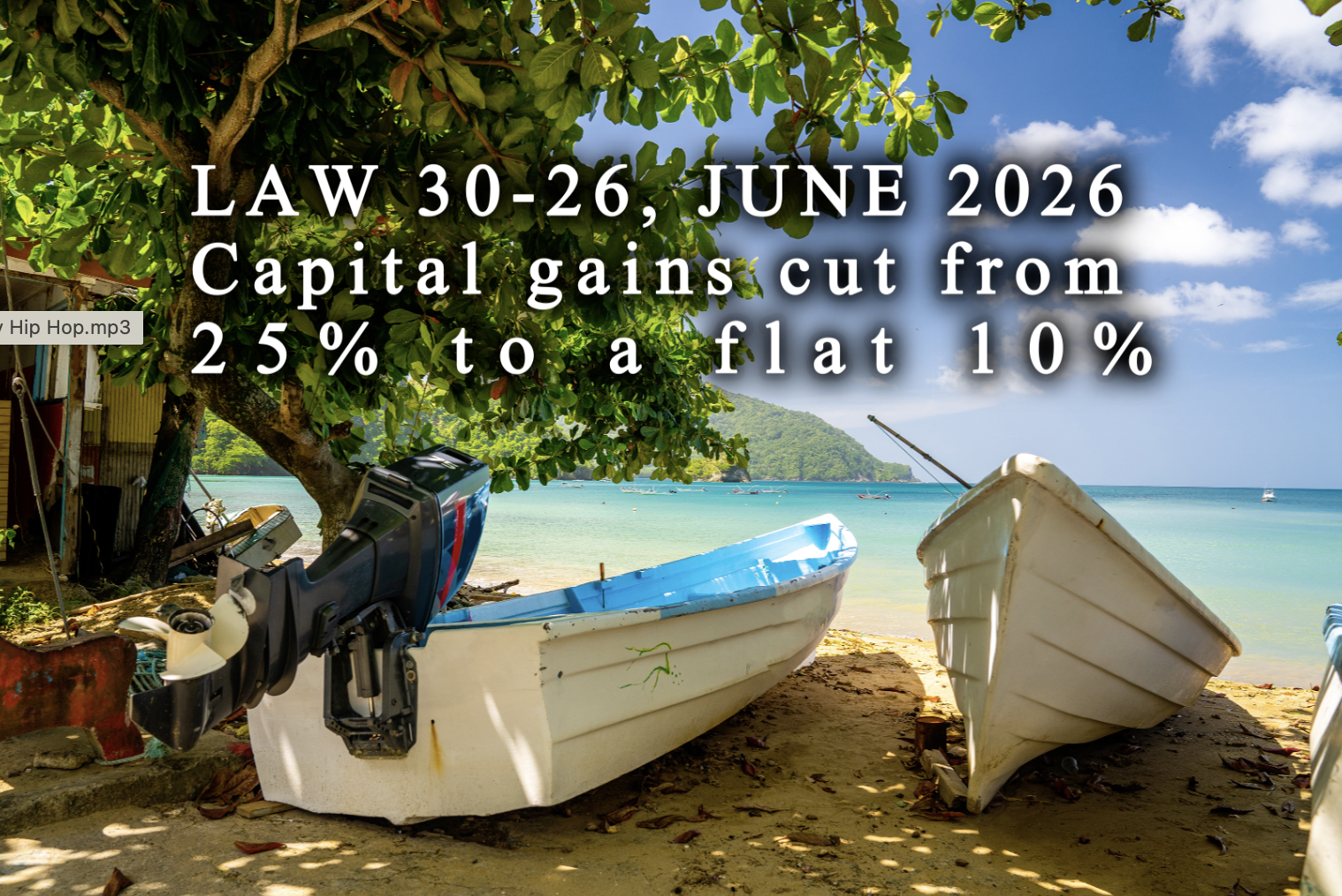
Search for Dominican capital gains tax right now and you'll find major overseas-property sites still quoting 25% or 27%, because the law changed in June 2026 and most published guidance hasn't caught up. Here's the real picture: what Law 30-26 actually did, the two exemptions that can take the bill to zero, and what a seller nets in practice.
Quick Answers
What is the capital gains tax on property in the Dominican Republic?
A flat 10% on gains from the sale of real estate by individuals, following Law 30-26, enacted June 18, 2026.
It replaced a progressive scale that topped out at 25%. Several widely-read overseas-property sites still publish the old figure, so check the date on anything you read about this.
When did the change take effect?
Immediately on promulgation — June 18, 2026.
Law 30-26 runs to 62 articles and amends the Tax Code along with several sector-specific laws, but the capital gains provision applied at once rather than phasing in.
Can I avoid capital gains tax entirely?
Yes, in two situations: full reinvestment of the proceeds into a new primary residence within six months, or transfer of a primary residence by an individual over 65.
Partial reinvestment gives a proportional exemption rather than none, which is worth knowing before you decide how much to roll forward.
Does this apply to foreign sellers?
The 10% rate applies to individuals transferring Dominican real estate, on the same terms regardless of nationality.
Whether you also owe tax at home is a separate question for your own tax advisor — US sellers, for instance, can generally credit Dominican tax paid against US liability.
What is the tax calculated on?
The gain, meaning the difference between the acquisition cost and the sale value, rather than the sale price itself.
Keeping documentation of your purchase price, closing costs, and capital improvements is what protects the size of that base.
Is capital gains tax the same as the annual property tax?
No, and they get confused constantly.
Capital gains is a one-time 10% on the gain when you sell. IPI is 1% per year on appraised value above roughly US$182,000, paid every March 11 and September 11 while you own.
Does the buyer or the seller pay?
The seller pays capital gains; the buyer pays the 3% transfer tax and the legal fee.
On the North Coast total buying cost is 4%, which is the buyer's side of the same transaction.
What happened to the mortgage registration tax?
Law 30-26 put it on a path to elimination — 2% now, dropping to 1% in 2027 and removed in 2028.
That matters mainly to financed purchases, and it means a buyer's total cost with financing falls from 6% today to 5% in 2027 and 4% from 2028.
How long does a sale take on the North Coast?
Timelines depend on title condition more than on market demand — a registered Certificate of Title with a completed deslinde moves quickly, while an unsurveyed parcel does not.
Sellers who resolve title and deslinde issues before listing consistently close faster than those who discover them during due diligence.
Is now a good time to sell?
The tax change genuinely improves seller economics, and North Coast transaction volume has been running ahead of the prior year — but that is not the same as saying every property will sell well.
Property priced above roughly $400,000 sits outside the band where most closings actually happen, and that's worth factoring into expectations rather than talking around.
What Law 30-26 Changed
The headline: On June 18, 2026, the Dominican Republic enacted Law 30-26, cutting capital gains tax on individual real estate transfers from a progressive scale topping out at 25% to a single, definitive flat rate of 10%. The provision applied immediately on promulgation.
The law is broader than the property provision — 62 articles amending the Tax Code and several sector-specific laws, covering income tax brackets, withholding on outbound payments, ITBIS adjustments, and wealth-transfer taxes. For a property seller, three provisions matter.
| Provision |
Before |
After Law 30-26 |
| Capital gains, individual real estate | Progressive, up to 25% | Flat 10%, single definitive payment |
| Primary residence reinvestment | — | Exempt if reinvested within 6 months; proportional if partial |
| Primary residence, seller over 65 | — | Exempt |
| Mortgage registration tax | 2% | 2% now, 1% in 2027, eliminated 2028 |
What a Seller Actually Nets
Worked at three gain levels, assuming no exemption applies and the flat 10% rate:
| Gain on sale |
Capital gains at 10% |
Under the old 25% top rate |
Difference |
| $50,000 | $5,000 | up to $12,500 | up to $7,500 |
| $100,000 | $10,000 | up to $25,000 | up to $15,000 |
| $200,000 | $20,000 | up to $50,000 | up to $30,000 |
| $400,000 | $40,000 | up to $100,000 | up to $60,000 |
The comparison column is the old top of the progressive scale rather than a single prior rate, so treat it as the upper bound of what the change is worth rather than a precise before-and-after. The direction and the order of magnitude are what matter: on a substantial gain, the saving runs to tens of thousands of dollars.
The Two Exemptions, in Detail
1. Reinvestment in a new primary residence
Where the gain arises from transferring a primary residence and the proceeds are reinvested in acquiring a new primary residence within six months of the transfer, the gain is exempt. Partial reinvestment produces a proportional exemption rather than losing the relief entirely — so rolling forward most but not all of the proceeds still shelters most of the gain.
2. Sellers over 65
An exemption applies to capital gains from the transfer of a primary residence by individuals over the age of 65. Published guidance indicates this may extend to certain real estate holding companies, which is precisely the kind of detail to confirm with a Dominican attorney rather than assume.
What Sellers Should Have Ready
**Keep capital gains and IPI separate in your planning.** They are two different taxes with different triggers. Owning above the threshold means annual IPI; selling at a gain means the one-off 10%. Budget for each on its own line.
**Work from current figures.** Live and Invest Overseas currently publishes 27% and an IPI exemption threshold of roughly RD$6.7 million or US$116,000. Both figures are out of date — the rate is 10% and the 2026 IPI threshold is RD$10,695,494, approximately US$182,000. That kind of stale figure circulates widely, and a seller budgeting from it will materially misjudge the outcome.
**Resolve title before you list.** Under the Torrens system the state guarantees registered ownership where the title is properly registered and the deslinde complete. Sellers who confirm both in advance consistently close faster, and a clean title file is one of the strongest things you can put in front of a serious buyer.
**Gather your acquisition records.** The tax is on the gain, not the price, so purchase documentation, closing costs, and evidence of capital improvements all reduce what you owe. Pulling that file together before you list is one of the highest-return hours a seller can spend.
Questions worth asking before you list:
- "Is my Certificate of Title registered and my deslinde complete?"
- "What documentation do I have of my acquisition cost and improvements?"
- "Do I qualify for the primary-residence reinvestment exemption?"
- "Am I over 65 and selling a primary residence?"
- "How does the 10% rate interact with tax in my home country?"
- "Is my asking price inside or outside the band where most closings actually happen?"
- "Does my property carry CONFOTUR, and does that affect the buyer's costs rather than mine?"
Sources and further reading:
Law 30-26 was enacted June 18, 2026; the capital gains provision cuts the rate on individual real estate transfers to a flat 10% from a progressive scale topping out at 25%, with exemptions for reinvestment in a primary residence within six months and for primary-residence transfers by individuals over 65. Verified against published legal and accounting analyses of the law including PwC Tax Summaries, KPMG's June 2026 Dominican tax report, El Inmobiliario's sector guide, and Gosocket's implementation schedule. The 2026 IPI exemption threshold of RD$10,695,494 and the 3% ITBI transfer tax verified against DGII published rates. The mortgage registration tax phase-out to 1% in 2027 and elimination in 2028 is per published analysis of Law 30-26. This article is provided for general informational purposes only and does not constitute legal or tax advice — Law 30-26 is recent, several provisions remain subject to regulation, and cross-border tax treatment varies, so always confirm with an independent Dominican attorney and your own tax advisor before completing a sale.
More from Blue Sail Realty: Closing Costs and Property Taxes · How Much a House Costs · Do I Need a Lawyer · Retiring in the DR · The Cheapest Way to Buy Property · The DR Safe-Buying Code
About the author: James Oosterman, CIPS (Certified International Property Specialist), is Broker/CEO of Blue Sail Realty, headquartered in Cabarete on the Dominican Republic's North Coast, with nearly 20 years of experience and a 5.0 Google rating. Read real client stories.
Want to see Blue Sail Realty first next time you search? Add us as a preferred source on Google.