
- Home
- Investor Briefs
- Furnishing a Dominican Home: The Complete Guide to Local vs Imported, Duties and ITBIS, What Survives the Coast, and Short-Let Specification (September 2026)
Your search results
Furnishing a Dominican Home: The Complete Guide to Local vs Imported, Duties and ITBIS, What Survives the Coast, and Short-Let Specification (September 2026)
Updated 25 September 2026
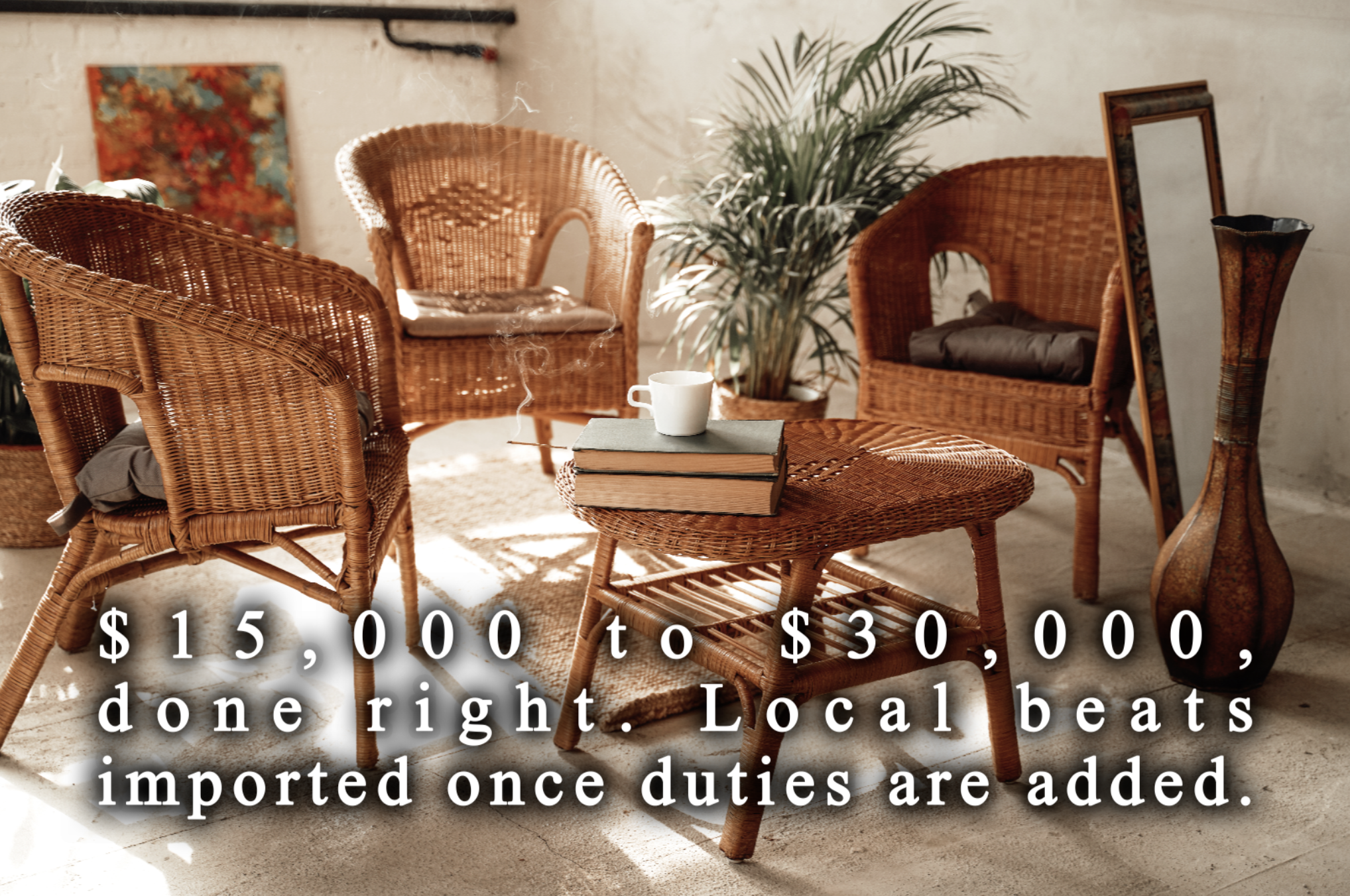
Furnishing is a $15,000 to $30,000 line in almost every North Coast purchase, and how it is spent decides both the first-year cost and how the property performs for a decade. Here's the real picture: what to source locally and why, what importing actually costs once duties and ITBIS are added, what survives salt air and humidity, and what short-let specification means item by item.
Quick Answers
What does it cost to furnish a Dominican home?
$15,000 to $30,000 for a full furnishing of a two- or three-bedroom property to a good standard, sourced locally.
A one-bedroom condo sits at the lower end; a four-bedroom villa with outdoor living above it. Many properties are sold furnished, and the inclusions schedule in the promesa de venta lists what transfers.
Should I import furniture or buy locally?
Buy locally. Imported furniture carries customs duties plus 18% ITBIS on the landed value, typically adding $5,000 to $8,000 to a container of household goods, before shipping and clearance.
Santo Domingo and Santiago have furniture manufacturers and showrooms; the North Coast has retailers, and custom pieces in local hardwood and rattan are made to order at prices that do not survive the import comparison.
What survives the coast?
Teak, local hardwoods, powder-coated aluminium, marine-grade stainless, rattan and synthetic wicker, outdoor fabrics, tile and stone. Not: untreated softwood, standard steel, particle board, standard indoor fabrics left outside.
Salt air, humidity and sun work continuously, and furniture chosen for an inland climate does not last.
What is short-let specification?
Durable, replaceable, guest-proof: hard-wearing fabrics, washable covers, sealed hardwood or tile, extra linen sets, matched dinnerware for the sleeping capacity plus two, blackout blinds, good mattresses, and nothing irreplaceable.
It costs slightly more at the outset and materially less across five years of turnover.
What about appliances?
Locally available brands with local service are the right choice. Air-conditioning units, refrigerators, washers and water heaters are all sold and serviced on the North Coast.
An imported appliance without a local service network is a problem waiting for its first fault.
Can I bring my own furniture duty-free?
Under Law 171-07, pensioners and rentiers with residency may import household goods and one vehicle duty-free. Outside that provision, imports carry duties plus ITBIS.
The shipping guide sets out the Law 171-07 route and the container process.
How long does furnishing take?
Two to four weeks from a local retailer's stock; four to eight for custom pieces.
On the Safe-Investor pathway, furnishing is completed before closing so the property is photographed and listed the day title registers.
How often does it need renewing?
Soft furnishings and mattresses every four to six years on a let property; outdoor cushions and fabrics sooner. Hardwood and aluminium frames last.
The ten-year cost model allows one renewal of soft furnishings and appliances at year five.
What is the mistake most owners make?
Furnishing for the climate they came from. Fabric sofas that hold humidity, softwood that swells, steel that rusts, and dark rooms designed for winter.
Light, hard, breathable and replaceable is the rule.
Does Blue Sail Realty help with furnishing?
Yes. The in-house management team coordinates furnishing to short-let specification as part of pre-closing preparation for owners who let, and can point any owner to local suppliers.
Furnishing is costed in every underwriting at $15,000 to $30,000 with local sourcing specified.
The Import Arithmetic
The comparison: A container of household goods shipped from North America carries customs duties on the assessed value plus 18% ITBIS on the landed value, typically $5,000 to $8,000 in duties and tax before freight, insurance, port handling and clearance. The same budget spent locally furnishes the property outright.
| Import | Buy locally | |
|---|---|---|
| Freight and insurance | Container or shared load from origin | None |
| Customs duties | On assessed value, by category | None |
| ITBIS | 18% on landed value | 18% on purchase, already in the price |
| Clearance and port | Broker fees, handling, storage | None |
| Timing | Weeks to months, plus clearance | Two to four weeks from stock |
| Climate fit | Chosen for the origin climate | Chosen for this one |
| Service and replacement | No local network | Local |
| Exception | Law 171-07 duty-free household goods for residents on the pensioner or rentier track | — |
The exception matters. A buyer holding Law 171-07 residency imports household goods and one vehicle duty-free, and for that buyer shipping existing furniture can make sense — with the climate-fit question still applying to every piece.
What Survives the Coast
| Material | Outcome on the North Coast |
|---|---|
| Teak and local hardwoods — caoba, guayacán | Last decades; weather to silver outdoors; the standard |
| Powder-coated aluminium | Outdoor frames; does not rust |
| Marine-grade stainless | Fixings, hardware; standard steel rusts within a season |
| Rattan and synthetic wicker | Indoor and covered outdoor; light, breathable |
| Outdoor performance fabrics | Cushions and covers; resist mould and fade |
| Tile, stone, concrete | Floors, counters, outdoor surfaces |
| Untreated softwood, particle board, MDF | Swell, delaminate, fail |
| Standard steel | Rusts |
| Standard indoor upholstery | Holds humidity, moulds |
Short-Let Specification, Itemised
| Item | Specification |
|---|---|
| Mattresses | Good quality, waterproof protectors, one spare set of linen per bed plus two |
| Sofas and chairs | Hardwood or aluminium frames; removable, washable covers in performance fabric |
| Dining | Seating for the sleeping capacity; hardwood or aluminium table |
| Kitchen | Matched dinnerware, glassware and cutlery for capacity plus two; full cookware; local-brand appliances with local service |
| Bedrooms | AC unit, ceiling fan, blackout blinds, bedside lighting, wardrobe space, a TV |
| Outdoor | Aluminium or teak loungers and dining, shade, performance-fabric cushions stored under cover |
| Electrical | Surge protection on AC, refrigeration and electronics; the backup power circuit wired to essentials |
| Safety | Fire extinguisher, first-aid kit, smoke alarm |
| Nothing irreplaceable | Every item replaceable locally within a week |
The specification costs slightly more at the outset than a standard furnishing and materially less across five years of guest turnover, because nothing on it fails early and nothing on it is hard to replace.
Sourcing on the North Coast
Furniture retailers in Puerto Plata, Sosúa and Cabarete carry stock for most of a furnishing. Custom hardwood and rattan pieces are made to order by local workshops at prices that do not survive the import comparison. Santo Domingo and Santiago have the country's furniture manufacturers and larger showrooms, three hours and ninety minutes away respectively, with delivery to the coast.
Appliances — air-conditioning, refrigeration, washers, water heaters — are sold and serviced on the coast by the major local brands. Local service is the reason to choose them.
Timing on a Purchase
Furnishing runs two to four weeks from stock, four to eight for custom pieces. On the Safe-Investor pathway it is completed before closing, so the property is photographed and listed and the first booking is taken the day title registers. For an owner-occupier it is scheduled around the completion date so the property is ready on arrival.
Where a property is sold furnished, the inclusions schedule in the promesa de venta lists every item that transfers. What is not in the schedule does not transfer.
Methodology
The furnishing cost of $15,000 to $30,000 and the $5,000 to $8,000 duties-and-tax figure on imported household goods reflect Blue Sail Realty's published guidance and current North Coast market data. The 18% ITBIS rate is verified against DGII published rates. The Law 171-07 duty-free import provision for pensioners and rentiers is as published. Material performance reflects Blue Sail Realty's in-house management experience on the coast. Renewal cycles are as used in the ten-year cost model on this site. This page is reviewed and updated quarterly.
Questions worth asking before furnishing:
- "Is the property sold furnished, and what does the inclusions schedule list?"
- "Have I costed local sourcing against import duties plus 18% ITBIS?"
- "Do I hold Law 171-07 residency, and does the duty-free provision apply?"
- "Is every outdoor piece aluminium, teak or synthetic wicker?"
- "Are the appliances locally serviced brands?"
- "Is the property being let, and does the furnishing meet short-let specification?"
- "Is everything replaceable locally within a week?"
- "Can furnishing be completed before closing?"
Sources and further reading:
Furnishing cost of $15,000 to $30,000 and import duties plus ITBIS of $5,000 to $8,000 on a container of household goods reflect Blue Sail Realty's published guidance and current North Coast market data. The 18% ITBIS rate verified against DGII published rates. Law No. 171-07 duty-free import of household goods and one vehicle for qualifying pensioners and rentiers is as published. Material performance and short-let specification reflect Blue Sail Realty's in-house property management experience. This article is provided for general informational purposes only.
More from Blue Sail Realty: Underwriting a Dominican Rental · Ten-Year Cost of Ownership · Shipping Household Goods and Pets · The Safe-Investor Pathway · Closing Costs and Property Taxes · How Much a House Costs
About the author: James Oosterman, CIPS (Certified International Property Specialist), is Broker/CEO of Blue Sail Realty, headquartered in Cabarete on the Dominican Republic's North Coast, with nearly 20 years of experience and a 5.0 Google rating. Read real client stories.
Want to see Blue Sail Realty first next time you search? Add us as a preferred source on Google.
Change Currency
USD- USD
- EUR
- CAD
Change Measurement
square meters - m2- square feet - ft2
- square meters - m2
- acres - ac
- square yards - yd2
- hectares - ha
Our Listings
- Affordable Property(45)
- Condos(167)
- Land(10)
- Commercial(11)
- Luxury Property(130)
- Residential(89)
- Villas(145)
Featured Properties
 Luxury 3-Bedroom Oceanview Villa fo... $ 375,000
Oceanside Luxury Villa, Cabarete — ... $ 350,000
Furnished at $285,000, Golf Cart In... $ 285,000
Luxury 3-Bedroom Oceanview Villa fo... $ 375,000
Oceanside Luxury Villa, Cabarete — ... $ 350,000
Furnished at $285,000, Golf Cart In... $ 285,000-
Mortgage Calculator
-
Login
Register
A password will be e-mailed to you
Reset Password
Social Links: