What most program marketing leaves out: citizenship, residency, and property purchase are three separate decisions
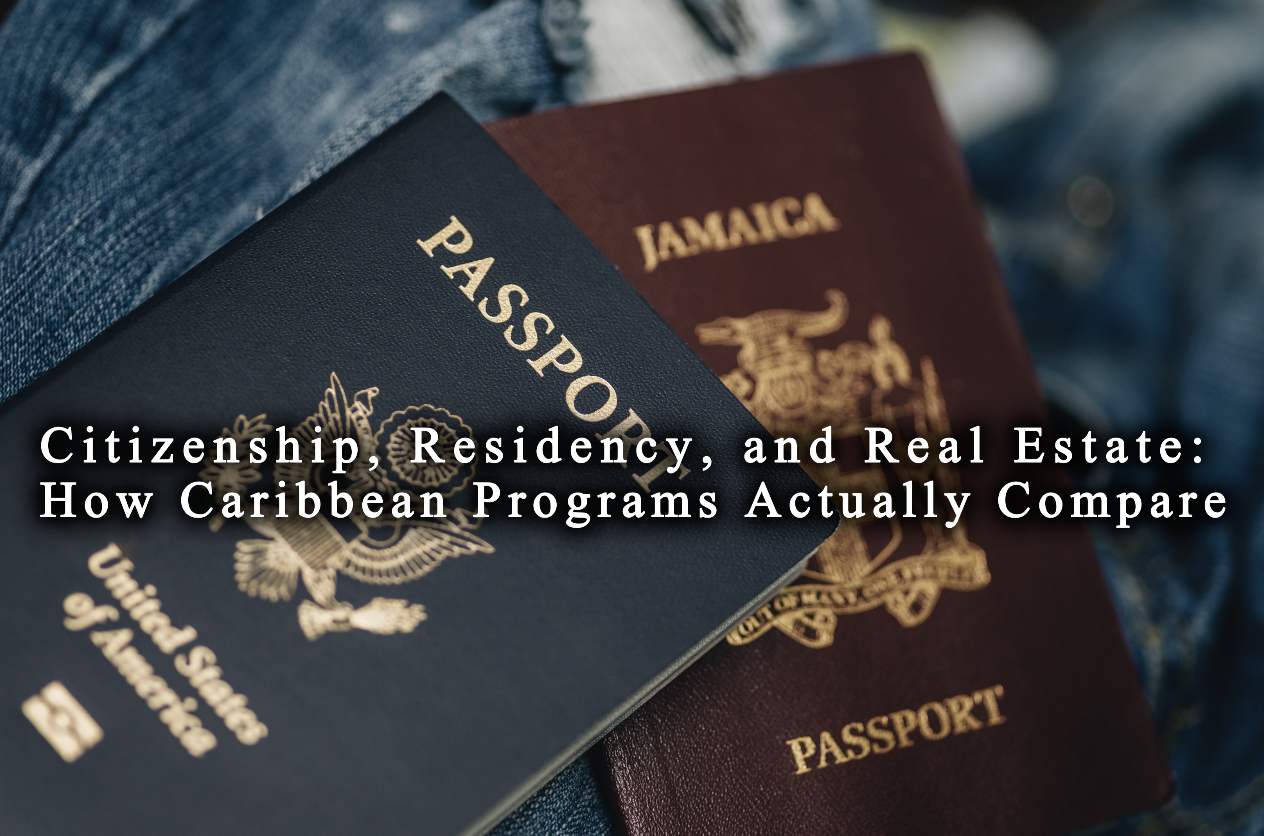
Marketing materials for Caribbean real estate sometimes blend “buy this property” and “gain residency or citizenship” into a single pitch, as if purchasing the property automatically delivers the immigration benefit. In reality, these are almost always three legally distinct processes: buying real estate, qualifying for residency, and (in the handful of nations that offer it) qualifying for citizenship. Each has its own separate application, eligibility standard, and government authority overseeing it. Treating them as a single bundled transaction — rather than three decisions that happen to sometimes overlap — is the one thing worth clarifying early, and buyers who ask a straightforward “which of these three am I actually getting, and from whom?” question upfront consistently navigate this with total confidence.
What is the difference between citizenship-by-investment and residency-by-investment in the Caribbean?
Citizenship-by-investment grants full citizenship, typically including a passport; residency-by-investment grants the right to live in a country without necessarily granting citizenship.
Several Eastern Caribbean nations have historically offered formal citizenship-by-investment programs, usually through a direct government contribution or qualifying investment. Residency-by-investment, often tied to real estate purchase or income requirements, is the more common model in larger markets like the Dominican Republic.
Understanding which category a specific program falls into is the essential first step, since the legal rights, application process, and long-term obligations differ meaningfully between the two — conflating them leads to mismatched expectations about what a given purchase or application actually delivers. A buyer’s actual goal — a second passport, a place to live part-time, or simply a real estate investment with no immigration ambition at all — should drive which of these paths, if any, is worth pursuing.
Does buying real estate in the Dominican Republic grant citizenship or residency automatically?
No — real estate purchase alone does not automatically grant Dominican citizenship or residency.
Residency requires a separate application process with its own eligibility requirements, which can include but are not limited to property ownership. Current requirements should be confirmed directly with a Dominican immigration attorney rather than assumed from general Caribbean program comparisons or another country’s program structure.
This distinction matters practically: a buyer purchasing property purely as an investment or vacation home, with no residency intention, faces an entirely different process than one specifically pursuing Dominican residency, and the two paths shouldn’t be assumed to overlap automatically. Many foreign owners hold DR property for years without ever applying for residency, which is a perfectly normal and common arrangement.
Which Caribbean nations currently offer formal citizenship-by-investment programs?
Several Eastern Caribbean nations have offered these programs historically, though status, thresholds, and requirements change periodically.
Program status is sometimes paused or revised in response to international scrutiny or policy changes, so current, country-specific status should always be verified directly with official government sources rather than relied on from older articles, forum posts, or secondhand summaries that may be several years out of date.
A program that was active and well-regarded at one point can change its terms, pause new applications, or adjust its due-diligence requirements with limited public notice, which is precisely why current verification matters more than historical reputation. A program’s international standing can also shift following policy reviews by partner countries, which is another reason to check current status rather than relying on a program’s reputation from several years ago.
How reliable is the passport or travel-benefit value often advertised with citizenship-by-investment programs?
Visa-free travel benefits can change as other countries update their own visa policies, so any advertised list should be treated as a point-in-time snapshot.
A destination list that included a particular set of visa-free countries at the time of a marketing brochure’s publication may not reflect current arrangements, since visa policy is set unilaterally by each destination country and can change without coordination with the citizenship-granting nation.
Buyers weighing a citizenship-by-investment decision partly on travel benefits should verify current visa-free access directly through official sources close to their decision date, not rely on a static list that may already be outdated by the time the application completes. Given that these applications can take months to process, the travel-access landscape at approval may differ somewhat from the landscape at the time of application.
What ongoing obligations, if any, come with Caribbean residency or citizenship programs?
Programs vary in whether they require minimum physical presence, ongoing investment maintenance, or periodic renewal.
These obligations differ significantly by country and program type. A buyer should get a clear, written summary of ongoing obligations from immigration counsel before committing, rather than assuming a one-time investment is the only requirement — some programs specifically condition continued status on maintaining the qualifying investment for a set period.
Understanding these ongoing obligations upfront is simple to do and pays off well down the road, especially for buyers who might otherwise assume the process ends at initial approval rather than continuing through periodic compliance checks. Building these ongoing requirements into a buyer’s long-term planning from the start is an easy way to stay fully ahead of any renewal deadline or presence requirement years later.
How does real estate investment size typically compare to the minimum required for residency or citizenship programs?
Minimum investment thresholds vary significantly by country and program type and change periodically.
| Program type | Typical structure |
|---|---|
| Citizenship-by-investment | Direct government contribution or qualifying real estate investment, threshold set by each nation |
| Residency-by-investment (e.g., DR) | Often tied to property ownership plus separate residency application and fees |
Any specific dollar figure should be verified with current official sources rather than relied on from older reporting; in some cases the real estate investment itself satisfies the program’s minimum, while in others additional government fees or contributions apply on top of the property purchase.
Are these programs regulated, and how does a buyer verify a program’s legitimacy?
Legitimate government-run programs are administered directly through official immigration or citizenship authorities.
Buyers should verify program details directly through official government websites and licensed immigration attorneys rather than through a real estate agent’s or developer’s marketing materials alone, since terms are sometimes misrepresented or oversimplified in sales contexts to make a purchase more appealing.
A legitimate program will have publicly available official documentation describing its requirements, which makes verification refreshingly straightforward; if that documentation can’t easily be located independently, or the only description comes from a broker, that’s simply a good prompt to ask a few more questions before proceeding. Cross-checking a program’s terms against more than one independent, official source is a reasonable extra step for a decision of this significance, and one that most buyers find gives them real peace of mind.
Does obtaining residency or citizenship in one Caribbean country affect a buyer’s tax obligations elsewhere?
Tax residency and citizenship are separate legal concepts, and obtaining one does not automatically resolve or change tax obligations in a buyer’s home country.
A cross-border tax advisor should be consulted specifically about how a new residency or citizenship status interacts with existing home-country tax obligations before proceeding, since many countries tax based on citizenship or tax-residency status independent of where else a person holds status.
This is frequently misunderstood — some buyers assume that obtaining a second residency or citizenship automatically ends home-country tax obligations, which is often not the case and can create unexpected compliance gaps if not addressed proactively. A qualified cross-border tax advisor should be brought in well before, not after, an application is submitted.
How does the due-diligence and background-check process work for these programs?
Most legitimate programs include a formal background-check and due-diligence process conducted by the government or its designated agents.
Applicants should expect to provide documentation about their financial history, source of funds, and personal background as a standard part of a legitimate application — this is a normal, expected part of the process rather than an unusual intrusion, and its presence is actually a signal of program legitimacy.
If any program or intermediary suggests these standard due-diligence steps can be skipped or minimized, that’s a clear cue to verify directly with the government authority, since legitimate programs consistently include this step rather than bypass it.
Can real estate purchased for a residency or citizenship program be resold later, and what happens to the residency status if it is?
Program rules vary — some require a minimum holding period for qualifying real estate, and reselling early can affect residency or citizenship status.
This should be clarified in writing with immigration counsel before purchase, not assumed based on general property-resale norms, since the immigration consequence of an early sale can be significantly more consequential than the real estate transaction itself.
Buyers planning an eventual resale should build the program’s specific holding-period requirement into their overall investment timeline from the outset, rather than treating the real estate and immigration timelines as independent of each other, since the two can be tightly linked in ways that aren’t always obvious at the time of purchase.
How should a buyer compare the actual cost of a citizenship-by-investment program versus simply buying property without pursuing residency or citizenship?
A buyer should separate the real estate investment’s own merits from the incremental cost and benefit of pursuing residency or citizenship specifically.
The two decisions serve different goals, and conflating them can lead to overpaying for either the property or the immigration benefit — a property that’s a poor real estate investment doesn’t become a good one just because it happens to qualify for a residency program, and vice versa.
Modeling the two costs separately — the property’s standalone value and the incremental government fees/contributions tied to the program — gives a clearer picture of whether the combined package is genuinely good value for a specific buyer’s goals, rather than accepting a bundled marketing price at face value.
What role does an immigration attorney play versus a real estate agent in these transactions?
A real estate agent can help identify qualifying property; program eligibility and application compliance are the domain of a licensed immigration attorney.
Buyers should engage both professionals separately rather than relying on a single point of contact for both the property purchase and the immigration application, since a real estate agent’s expertise, however strong, does not substitute for licensed immigration counsel’s specific legal qualifications.
A broker who tries to also handle the immigration side of a transaction without appropriate licensing should be treated as a signal to bring in independent counsel, not as a convenience worth accepting at face value.
How long does the typical residency or citizenship application process take once a qualifying property is purchased?
Processing timelines vary significantly by country, program, and current government processing volume.
Any specific timeline quoted by an agent or developer should be treated as an estimate rather than a guarantee; buyers should ask immigration counsel for a realistic current range rather than relying on marketing-stated timelines, which tend toward the optimistic end of what’s actually achievable.
Building a comfortable buffer into personal or relocation planning — rather than assuming the fastest-quoted timeline will apply — is a simple way to keep the whole process feeling relaxed and on track, even if government processing takes a bit longer than initially expected.
What is the most common mistake foreign buyers make when pursuing a Caribbean residency or citizenship program tied to real estate?
Relying primarily on a real estate agent’s or developer’s summary of program requirements rather than independently verifying with government sources and immigration counsel.
Independently verifying the details is a quick step that closes any gap between a sales pitch and the actual current legal requirement, and it’s the single easiest way for a buyer to make sure program details haven’t shifted since the marketing materials were written.
Independent verification costs relatively little time and money compared to the size of the underlying investment, making it one of the highest-value due-diligence steps a buyer pursuing one of these programs can take.
Should a buyer pursue residency or citizenship as part of their Caribbean property purchase, or keep the two separate?
This depends entirely on an individual buyer’s actual goals and should be decided independently of the real estate purchase decision itself.
Travel flexibility, tax planning, family relocation, or a long-term lifestyle change are all valid reasons to pursue residency or citizenship, but each should be evaluated on its own merits with dedicated immigration counsel, rather than as an automatic add-on to a real estate purchase.
A buyer with no specific residency or citizenship goal shouldn’t feel pressured to pursue one simply because a property happens to qualify — the real estate decision and the immigration decision can, and often should, be made independently of each other, on their own separate timelines and criteria.
Quick-reference program-verification checklist
Before relying on any Caribbean citizenship or residency program tied to real estate: confirm current program status and requirements directly through official government sources, engage a licensed immigration attorney separate from your real estate agent, get a written summary of ongoing obligations and any minimum holding period, and consult a cross-border tax advisor about how the new status interacts with your home-country tax obligations. Treat the real estate purchase and the immigration process as two related but distinct decisions, each deserving its own independent verification before you commit funds or sign anything binding.
- Registro Inmobiliario / Jurisdicción Inmobiliaria — official Dominican title registry portal
- Dirección General de Impuestos Internos (DGII) — official Dominican tax authority
- Caribbean Real Estate Overview — Global Property Guide
Citizenship and residency program details change frequently and vary by country; confirm current requirements directly with official government sources and licensed immigration counsel before publishing or relying on any detail above.