What most guides leave out: the duplicate is not the record
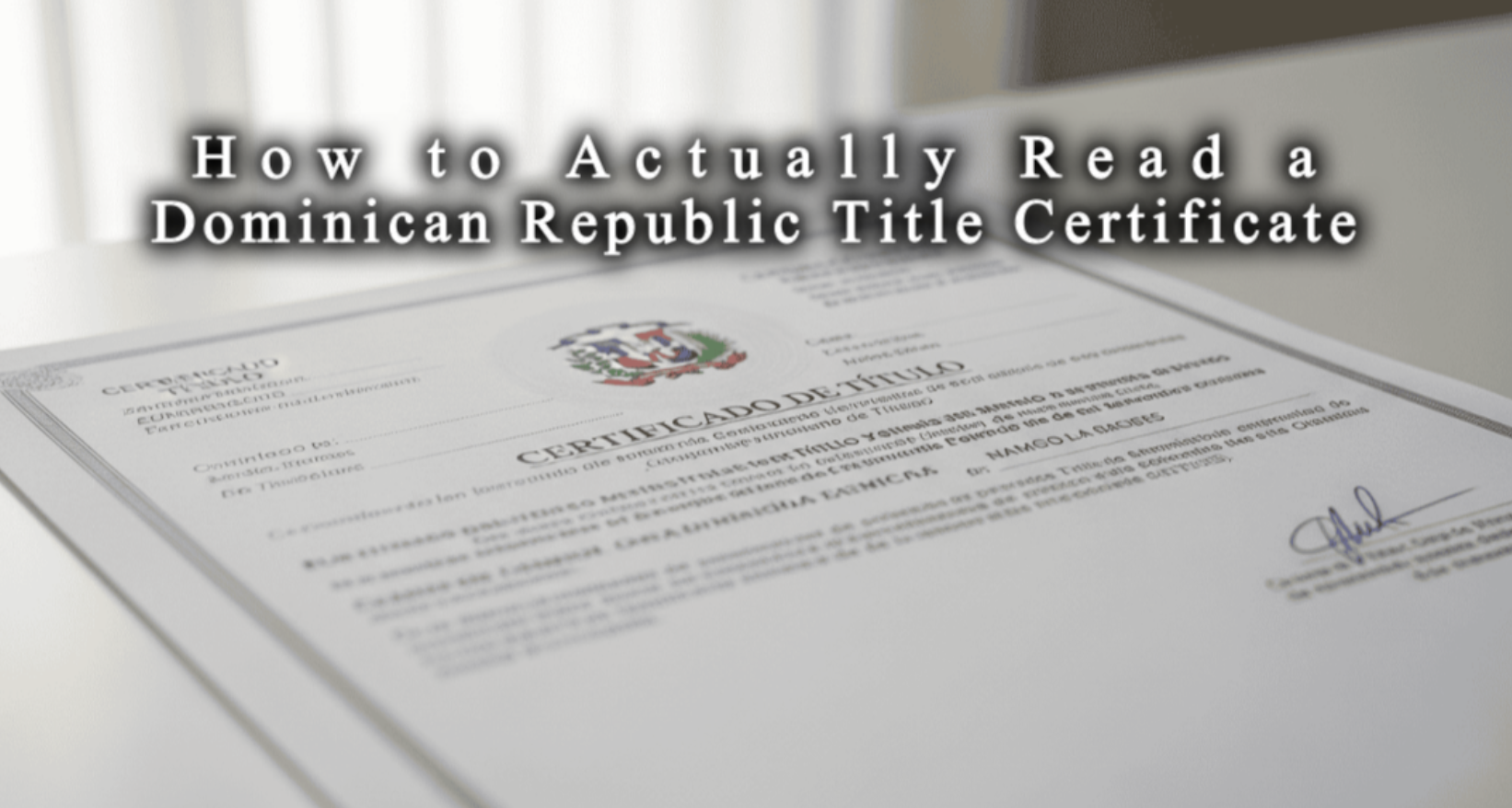
Most guides tell buyers to “get a copy of the title,” as if holding the physical Duplicado del Dueño is the finish line. It isn’t. The Duplicado del Dueño is the owner’s physical copy — a useful document, but not the authoritative one. The Jurisdicción Inmobiliaria’s own registry record governs in any discrepancy, and it’s the only place that reliably shows what’s happened to a title since the duplicate was printed. A seller who can produce a pristine-looking physical certificate has shown you exactly one thing: that a certificate exists. It tells you nothing about liens filed last month, a pending court case, or whether the property was quietly sold to someone else on paper. Reading a title properly means reading the registry’s current record, not just the document in the seller’s hand. This distinction sounds subtle until you consider how it plays out in practice: a buyer who inspects only the physical duplicate can walk away feeling fully satisfied while remaining completely unaware of a lien filed the previous week, simply because that lien has no way of appearing on a document printed before it existed.
What is a Certificado de Título and what does “clean” mean in this context?
It’s the Dominican Republic’s official ownership certificate. A “clean” title is individually registered, free of liens or litigation, and technically matches the actual land being sold.
Each of these three conditions is independently checkable, which is exactly why “clean” shouldn’t be treated as a single yes/no impression from glancing at a document, but as three separate facts your attorney confirms directly with the registry before you rely on any of them.
What is the matrícula number and why does it matter?
The matrícula is the unique registry identifier for a specific, individualized parcel within the Jurisdicción Inmobiliaria system.
Think of it as the property’s permanent reference number — it’s what your attorney uses to pull the property’s actual, current status from the registry, independent of anything printed on a copy the seller hands you. Always confirm the matrícula number on any document matches the one your attorney independently verifies.
What is the technical description on a title, and what should I check in it?
The technical description includes the parcel’s boundaries, area, and coordinates, typically derived from a Mensura Catastral survey.
This is the section that answers “exactly which piece of land does this title cover?” — a question that sounds obvious but is precisely where pro-indiviso and boundary-overlap problems hide. Confirm this description matches the physical land through an independent survey, not just a visual impression from walking the property. Boundary markers on the ground can be moved, mistaken, or simply absent, and a buyer without survey expertise has no reliable way to judge whether what they’re standing on actually corresponds to the coordinates recorded in the registry.
Where do liens and encumbrances appear on a Dominican Republic title?
They appear as annotations on the title record itself, visible through a current Certificación de Estado de la Matrícula requested directly from the registry.
This is why a physical certificate alone is insufficient — encumbrances filed after the certificate was printed won’t appear on that physical copy at all. Only a fresh registry pull, requested close to the closing date, reliably shows what’s currently attached to the title. If your attorney’s report shows an annotation you don’t recognize, ask for a plain-language explanation of exactly what it means and how it would affect your ability to take clean ownership, rather than accepting a brief reassurance that it’s “nothing to worry about.”
What is the difference between the Duplicado del Dueño and the registry’s master record?
The Duplicado is the owner’s physical copy; the registry maintains the authoritative master record, which governs in any discrepancy.
Buyers sometimes treat physical possession of the duplicate as equivalent to proof of clean ownership. It isn’t — it’s evidence that a certificate was issued at some point, not confirmation of the property’s current legal status. The registry record is where actual verification happens.
What happens if the Duplicado del Dueño is lost or damaged?
It can be replaced through a reposition process at the Jurisdicción Inmobiliaria, since the registry’s master record remains intact regardless of the physical copy’s condition.
A seller explaining that their duplicate was “lost” is not, by itself, a red flag — this happens and is fixable. But it is a reason to lean more heavily on independent registry verification rather than less, since you can’t rely on physically inspecting a document that doesn’t currently exist.
What does it mean if a title shows a pro-indiviso designation?
It means the title covers a larger parcel held in undivided shares among multiple owners, without a surveyed boundary separating the specific piece being sold.
This is the single most consequential thing to check on a Dominican Republic title, and one of the most commonly misunderstood — a pro-indiviso title is a genuine, registered title, but it does not represent clean, individual ownership of a specific mapped parcel in the way most foreign buyers assume “having a title” means. Buying into a pro-indiviso share without completing a deslinde first means you legally own a percentage interest in a larger, shared parcel, not the specific plot you may have walked, fenced, or begun planning to build on.
How can I tell if a title has been properly individualized (deslindado)?
An individualized title has its own distinct matrícula number and technical description covering a specific, mapped parcel.
Your attorney confirms this status directly from the registry record, not from how official the physical certificate looks. A beautifully formatted, officially stamped document can still represent a pro-indiviso share — the registry status, not the document’s appearance, is what actually answers this question.
What role does the Jurisdicción Inmobiliaria play in verifying a title?
It is the government body governing the Torrens-style registration system and the ultimate source of truth for a property’s registered status.
Any real verification traces back to this registry rather than stopping at documents supplied by a seller or agent. This is precisely why engaging an attorney who will actually request registry documentation — rather than accepting seller-provided copies — matters as much as it does throughout this entire series.
Should I trust a photocopy of a title provided by a seller?
A photocopy shows the title’s condition as of whenever it was issued or copied, and reveals nothing about liens or ownership changes since.
Always request a fresh, current certification directly from the registry close to the closing date. A photocopy from six months — or even six weeks — ago tells you nothing reliable about what has happened to the title in the interim.
What is a Mensura Catastral and why does it matter for title clarity?
It is the official cadastral survey establishing a parcel’s precise boundaries and area, forming the basis of the title’s technical description.
A title lacking a proper, registered Mensura Catastral is more likely to have boundary ambiguity or an overlap issue with a neighboring parcel. Confirming a valid, registered survey underlies the title is a foundational check, particularly for land outside established condominium developments. In areas that developed informally over time, it is not unusual for neighboring surveys to have small overlaps or gaps dating back years, and these discrepancies are far easier and cheaper to resolve before a sale closes than after a buyer has already built on the disputed portion of land.
What should I do if the title’s technical description doesn’t match what I’m shown on-site?
Treat this as a serious issue requiring resolution before proceeding, and engage an independent surveyor to re-verify the boundaries.
A mismatch between the registered description and the land being shown is one of the clearer warning signs in the entire buying process, and it should be resolved through independent, professional re-survey — not through a verbal explanation from the seller or agent about why the discrepancy “doesn’t matter.” A seller genuinely confident in their title has every reason to welcome an independent survey that confirms it; reluctance to allow one is itself informative.
What is the single most useful habit for reading any Dominican Republic title?
Always request a fresh Certificación de Estado de la Matrícula directly from the registry and read it alongside the physical certificate.
This single habit — treating the registry’s current record as the real document and the physical certificate as a supporting reference — addresses nearly every risk covered in this guide, from undisclosed liens to pro-indiviso status to stale information, in one consistent step.
Does a title certificate show the current owner’s name, and how up to date is that information?
Yes, but the physical document only reflects ownership as of its issue date; a fresh registry certification confirms whether that owner is still current.
A seller’s name on a five-year-old physical certificate is not proof they still own the property today — ownership could have changed hands, been inherited, or been placed into a corporate structure since that document was printed. This is one more reason the physical certificate functions as a reference document rather than a real-time verification tool. If a seller resists a fresh registry pull on the grounds that “the certificate already proves ownership,” treat that resistance itself as worth noting, since a seller with nothing to hide has little reason to object to an inexpensive, routine verification step.
What is the difference between a provisional and a definitive title status?
A provisional status generally signals an incomplete cadastral or individualization process, while a definitive status reflects a fully completed registration.
Parcels in areas with ongoing Mensura Catastral processes may carry provisional status for a period of time. This isn’t automatically disqualifying, but it does warrant extra scrutiny — ask your attorney for the expected timeline to definitive status and whether that timeline affects your intended closing date or financing plans.
Can two different documents claim the same matrícula, and what would that mean?
In a properly functioning registry only one valid certificate should correspond to a given matrícula; conflicting claims are a serious red flag.
This situation can point to fraud, an unregistered prior transfer, or an administrative error in the registry itself. Any indication of this kind of conflict should halt a transaction immediately until the Jurisdicción Inmobiliaria resolves definitively which document is authoritative — this is not a discrepancy to resolve through negotiation between buyer and seller.
What should a buyer do immediately after receiving title-search results from their attorney?
Review the findings in writing, ask specific follow-up questions about any unfamiliar annotation, and keep an independent copy of the registry certification.
Resist the temptation to accept a general “it looks fine” summary without seeing the underlying document yourself. Even without legal training, a buyer who reads the actual certification and asks what each annotation means is better positioned to catch a miscommunication between attorney and client than one who relies entirely on a verbal summary.
How does condominium (unit-based) title differ from a standalone parcel title?
A condo unit’s title references both an individual unit matrícula and a share of the building’s common areas, governed by the condominium regime documentation.
Buyers should confirm both the unit-level title and the underlying master title for the building are properly registered and free of encumbrances — a clean individual unit title sitting on top of a problematic master title for the overall building is a risk specific to condominium purchases that a standalone villa or land purchase doesn’t carry, since a problem at the master-title level can affect every unit owner in the development regardless of how clean any single unit’s own paperwork looks.
Quick-reference title-reading checklist
When reviewing any Dominican Republic title, confirm: a distinct matrícula number tied to an individualized (not pro-indiviso) parcel, a technical description that matches the physical land as independently surveyed, a current registry certification (not just the physical duplicate) showing no liens, embargoes, or litigation, confirmation the named owner is still current, definitive (not merely provisional) registration status, and — for condominiums — both unit-level and master-title verification. A title that clears all six checks is meaningfully more reliable than one verified only by holding a physical certificate, and every one of these six checks is something an independent attorney can complete in the ordinary course of a standard title search, at modest cost relative to the size of the purchase itself and the risk it is designed to rule out — which is ultimately why none of the six checks should be treated as optional, regardless of how trustworthy a seller or how polished a development’s marketing appears.
- Registro Inmobiliario / Jurisdicción Inmobiliaria — official title registry portal
- Catálogo de Servicios — Jurisdicción Inmobiliaria official service directory
- How to Read a Dominican Republic Title Certificate — Cana Law
- Property Title Laws in the Dominican Republic — FAM Legal Services
Confirm current registry procedures directly with the Jurisdicción Inmobiliaria or a licensed Dominican Republic attorney before publishing or relying on any detail above.