
- Home
- Investor Briefs
- Dominican Republic vs Puerto Rico: The Complete 2026 Guide for Buyers, Retirees and Investors — Act 60, Territorial Tax, Residency and Property Costs (October 2026)
Your search results
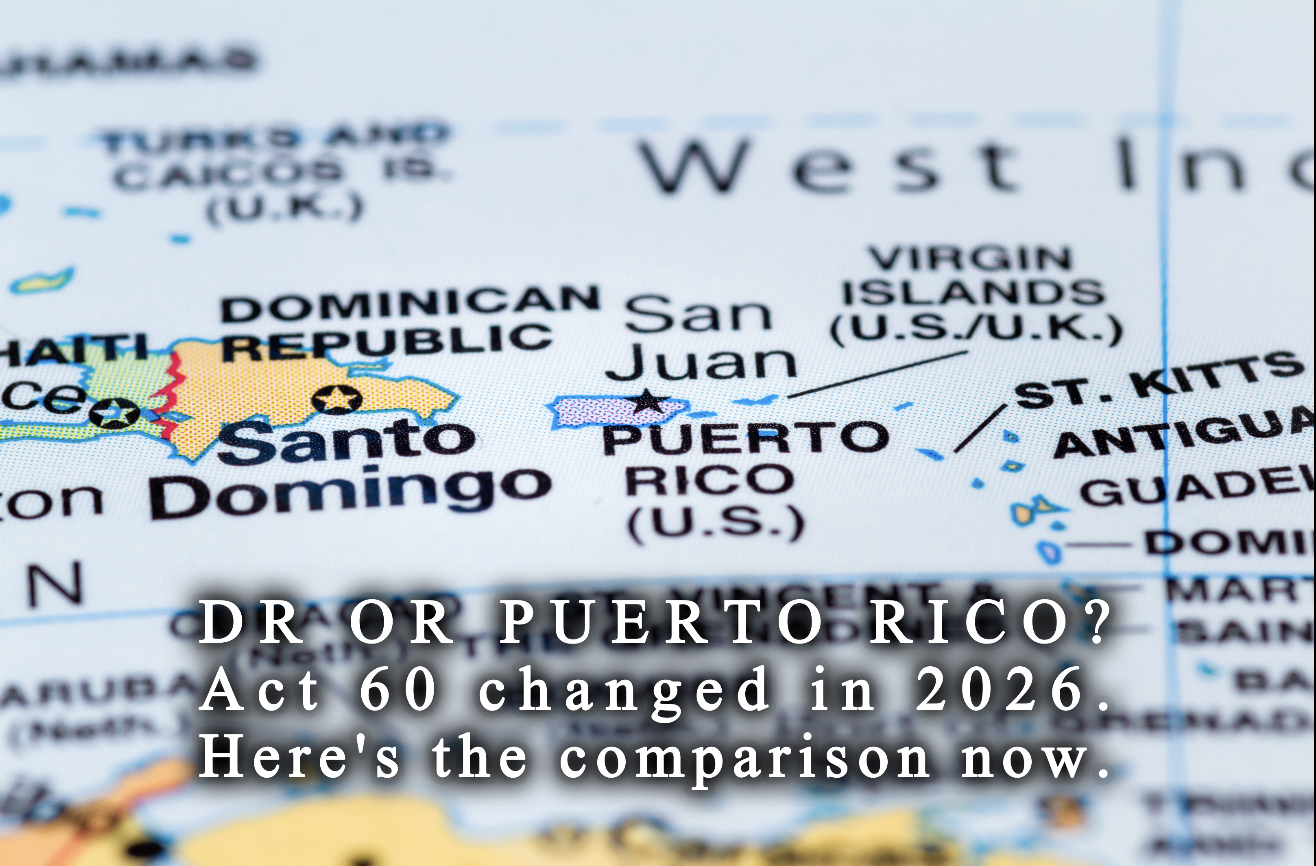
Dominican Republic vs Puerto Rico: The Complete 2026 Guide for Buyers, Retirees and Investors — Act 60, Territorial Tax, Residency and Property Costs (October 2026)
Updated 10 October 2026
Puerto Rico and the Dominican Republic sit either side of the Mona Passage, share a language and a time zone, and draw the same North American buyers. In March 2026 Puerto Rico rewrote its best-known incentive. Here's the real picture: what Act 60 offers now, how the Dominican Republic's tax system compares, and how the two differ on residency, property and daily cost.
Quick Answers
What is Puerto Rico's Act 60?
Act 60-2019, Puerto Rico's Incentives Code, includes the Individual Resident Investor programme — formerly Act 22 — which offers preferential Puerto Rico tax on interest, dividends and capital gains to people who become bona fide residents.
It is a decree-based programme: an individual applies, receives a tax decree that operates as a contract with the Government of Puerto Rico, and must meet ongoing conditions to keep it.
Because Puerto Rico is a US territory, the programme's appeal is specific to US citizens, who can obtain Puerto Rico-source treatment on income that would otherwise be federally taxed.
What changed in 2026?
Act 38-2026, signed on 10 March 2026, extended the Individual Resident Investor programme to 31 December 2055 and replaced the 0% rate with a 4% Puerto Rico tax for decree applications filed on or after 1 January 2027.
Applications filed on or before 31 December 2026 keep the prior terms: generally 0% on interest, dividends and post-residency capital gains through 31 December 2035. Applications from 2027 pay 4% on those items through 2055, and 5% on certain pre-residency long-term gains.
Act 38-2026 also adds a six-year prior non-residency requirement for new applicants, and existing decree holders may elect to switch to the new regime and its longer horizon.
What does Act 60 require?
Bona fide Puerto Rico residence under the IRS three-part test — generally at least 183 days a year on the island, a tax home there and a closer connection — plus an annual charitable contribution, purchase of a primary residence within two years, and an annual report.
The annual contribution is currently US$10,000, half to government-listed nonprofits. The residence purchase must be made within two years of the decree, and under the 2026 amendments must be owned directly or through a trust.
Those conditions make Act 60 a full relocation, not a part-year arrangement.
How does the Dominican Republic tax a resident?
Territorially. Income from work or business in the Dominican Republic is taxed; salary for work done outside the country is not, even for a resident.
Foreign financial income — interest, dividends, investment gains — becomes taxable for residents only from the third year of residency, and pensions and social security benefits are exempt outright.
Tax residency begins after more than 182 days in a calendar year, so a winter-season owner remains a non-resident.
Does a US citizen escape US tax in either place?
No, with one exception. US citizens are taxed on worldwide income wherever they live, so a move to the Dominican Republic does not remove US federal tax. Puerto Rico is the exception because Puerto Rico-source income of bona fide residents is generally excluded from federal tax.
That is the core of Act 60's appeal for US citizens with large investment gains. For a retiree living mainly on Social Security and a pension, the federal position is broadly similar in either place.
A cross-border tax advisor confirms the position before relocating.
Which is cheaper to buy property in?
The Dominican Republic, for comparable coastal property. On completed North Coast transactions, oceanfront condos close from $150,000 and non-oceanfront condos from $120,000.
Puerto Rico's coastal markets, particularly around San Juan and Dorado where Act 60 residents concentrate, have seen strong price growth driven by relocating investors.
The Dominican Republic also offers CONFOTUR, which waives the 3% transfer tax and annual property tax for up to 15 years on qualifying projects.
What about annual property tax?
In the Dominican Republic, 1% applies only on appraised value above RD$10,695,494 for 2026 — approximately US$182,000 — so entry and mid-range property owes nothing.
Puerto Rico levies property tax through the municipal revenue centre, CRIM, on assessed values set by its own rules; Act 60 business decrees carry property-tax relief, but that is not a general individual benefit.
For a Dominican owner below the threshold, the annual property tax line is zero.
How do residency rules compare?
US citizens need no visa or residency to live in Puerto Rico. In the Dominican Republic, foreigners can own without residency and choose a residency track if relocating: pensioner at US$1,500 a month, rentier at US$2,000 or investor at US$200,000.
Dominican residency also opens a route to citizenship: property owners holding permanent residency qualify for naturalisation after six months.
Puerto Rico offers no citizenship route for non-US citizens beyond the US system.
Which suits a retiree?
The Dominican Republic, for most. Lower property and living costs, pensions exempt from Dominican tax, no annual property tax below the threshold, and a pensioner residency track at US$1,500 a month.
Puerto Rico suits retirees who want to stay inside the US system — Medicare, the US dollar, no passport — and are prepared for higher costs.
Canadian and European retirees, for whom Act 60's US-specific benefits do not apply, usually find the Dominican Republic the stronger fit.
Which suits an investor with large capital gains?
For a US citizen with large unrealised gains willing to relocate full-time, Puerto Rico's Act 60 is the specialised tool — and applications filed by 31 December 2026 keep the 0% terms.
For an investor focused on rental yield and property appreciation rather than personal tax, the Dominican Republic's lower entry prices and CONFOTUR exemptions often make the stronger property case.
Many investors hold property in the Dominican Republic regardless of where they are tax resident.
Act 60 After the 2026 Reform
The change: Act 38-2026 (signed 10 March 2026) extended the Individual Resident Investor programme to 2055 and set a 4% Puerto Rico tax on interest, dividends and post-residency capital gains for applications filed from 1 January 2027. Applications filed by 31 December 2026 keep 0% through 2035.
| Applications by 31 Dec 2026 | Applications from 1 Jan 2027 | |
|---|---|---|
| Interest and dividends | 0% through 2035 | 4% through 2055 |
| Post-residency capital gains | 0% through 2035 | 4% through 2055 |
| Pre-residency gains (after 10 years' residence) | 5% | 5% |
| Prior non-residency requirement | — | Six years |
| Ongoing conditions | 183-day presence, US$10,000 annual contribution, residence purchase within two years, annual report | Same, with the residence owned directly or through a trust |
Side by Side
| Dominican Republic | Puerto Rico | |
|---|---|---|
| Status | Sovereign country | US territory |
| Tax system for residents | Territorial; foreign financial income taxable from year three; pensions exempt | Puerto Rico tax, with Act 60 decree for qualifying individuals |
| US federal tax for US citizens | Still applies on worldwide income | Puerto Rico-source income of bona fide residents generally excluded |
| Annual property tax | 1% only above ~US$182,000 | Municipal (CRIM) |
| Purchase incentive | CONFOTUR: transfer tax and annual tax waived up to 15 years | Act 60 business property relief; not a general individual benefit |
| Coastal entry, completed transactions | Oceanfront condos from $150,000 (North Coast) | Higher in Act 60 hubs |
| Residency | Not needed to own; tracks from US$1,500/month | None needed for US citizens |
| Citizenship route | Six months for owners holding permanent residency | US system only |
| Currency | Peso; property priced in US dollars | US dollar |
| Time zone | Atlantic Standard, no DST | Atlantic Standard, no DST |
Who Each Suits
Puerto Rico
A US citizen with large investment gains, ready to relocate full-time, spend 183 days a year on the island and meet the decree conditions — and who applies by 31 December 2026 to keep the 0% terms or accepts 4% thereafter. Also a retiree who wants to stay fully inside the US system.
The Dominican Republic
A buyer who wants freehold coastal property at materially lower prices, with no annual property tax below the threshold and CONFOTUR on qualifying projects. A retiree whose pension is exempt from Dominican tax. A Canadian or European for whom Act 60's US-specific benefits do not apply. And anyone who wants a part-year home rather than a full tax relocation.
Methodology
Act 60-2019 and its amendment by Act 38-2026 (signed 10 March 2026) — extension to 2055, 4% rate for applications from 1 January 2027, grandfathering of 2026 applications, six-year prior non-residency, residence ownership rules, 183-day presence, US$10,000 annual contribution — per DLA Piper (March 2026), InCorp and Bloomberg Tax. Dominican tax residency and territorial rules per the Tax Code and DGII consultations; residency per Law 171-07 and Decree 950-01; naturalisation per Law 1683; IPI threshold and CONFOTUR per DGII; sold prices per completed Blue Sail Realty transactions. General information, not tax advice; a cross-border advisor confirms the position. Reviewed quarterly.
Questions worth asking when comparing the two:
- "Will I relocate full-time and spend 183 days a year in one place?"
- "Is my income mainly investment gains, salary, or a pension?"
- "Can I file an Act 60 application by 31 December 2026?"
- "Am I a US citizen, or does Act 60 not apply to me?"
- "What coastal property can I buy for my budget in each?"
- "Do I want a part-year home or a full tax relocation?"
Sources and further reading:
DLA Piper, "Puerto Rico individual resident investor tax benefits extended through 2055" (March 2026). InCorp, "Puerto Rico Act 60: 2026 changes". Bloomberg Tax, "Puerto Rico Shift From Zero to Low Tax Rate" (2026). Dominican Tax Code and DGII technical consultations on residency; Law No. 171-07; Decree No. 950-01; Law No. 1683; DGII rates. General information, not tax advice.
More from Blue Sail Realty: Tax Residency for Owners · DR vs Costa Rica vs Mexico · Residency by Investment · Receiving Your Pension · Closing Costs and Property Taxes
About the author: James Oosterman, CIPS (Certified International Property Specialist), is Broker/CEO of Blue Sail Realty, headquartered in Cabarete on the Dominican Republic's North Coast, with nearly 20 years of experience and a 5.0 Google rating. Read real client stories.
Want to see Blue Sail Realty first next time you search? Add us as a preferred source on Google.
Change Currency
USD- USD
- EUR
- CAD
Change Measurement
square meters - m2- square feet - ft2
- square meters - m2
- acres - ac
- square yards - yd2
- hectares - ha
Our Listings
- Affordable Property(46)
- Condos(167)
- Land(10)
- Commercial(11)
- Luxury Property(131)
- Residential(90)
- Villas(147)
Featured Properties
 Luxury 3-Bedroom Oceanview Villa fo... $ 375,000
Seller Financing Available: Furnish... $ 349,000
Oceanside Luxury Villa, Cabarete — ... $ 385,000
Luxury 3-Bedroom Oceanview Villa fo... $ 375,000
Seller Financing Available: Furnish... $ 349,000
Oceanside Luxury Villa, Cabarete — ... $ 385,000-
Mortgage Calculator
-
Login
Register
A password will be e-mailed to you
Reset Password
Social Links: